Mark of the Fool is a Progression Fantasy series geared toward a young adult audience, featuring light romance, action, PG-13 violence, and epic adventures packaged with an interesting twist on the genre.
The following review is based on books 1-3 of the series.
Review 7/10
Mark of the Fool is a solid entry into a fairly routine genre. Progression Fantasy takes many forms, but it tends to follow the big names in theme and general style. Mark of the Fool breaks that trend, setting its own path.
An interesting magic system combines well with a refreshing take on the “Hero’s Party” trope. I respect the gumption to take a tried and true plot device and turn it on its head.
Add on an adorable little sister character, a slow build childhood friend romance plot, and a lovably snarky protagonist and you’re in for an adventure!
While I’m not yet totally invested, fans of the above will find themselves whisked away into a familiar world—with a twist!
Score: A Very Subjective 7/10 *9/10 for lovers of magic school fiction*
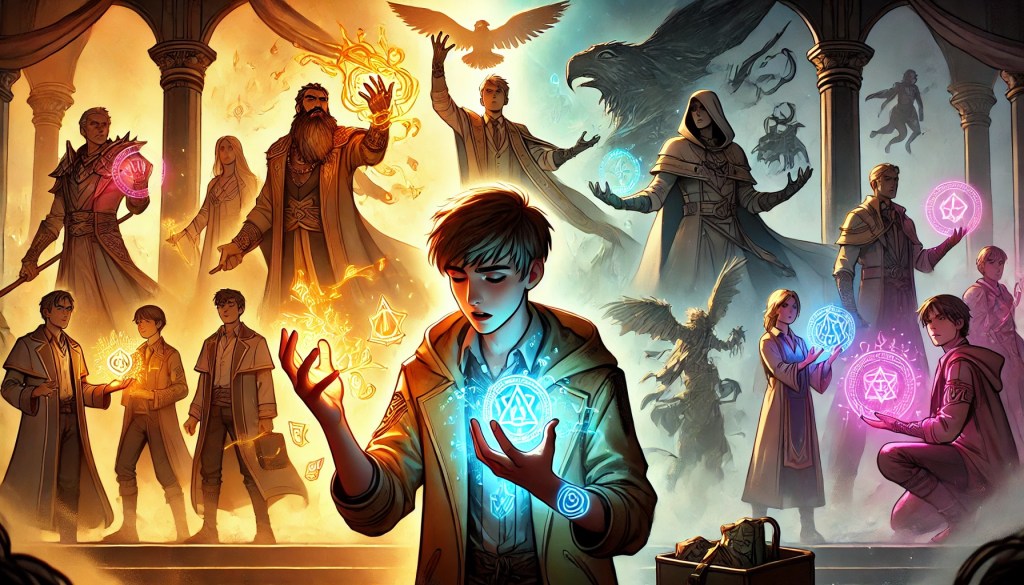
The Heroes Receive Their Marks
Summary
Mark of the Fool opens very traditionally. We get a young adult male protagonist looking forward to the future as he lives a somewhat mundane life in generic fantasy world X.
Our protagonist, Alex, is primed to set off to the big city, for wizard college. He has a letter of acceptance, funds for travel due to inheriting his late family’s savings upon turning 18, and he’s all set to take his little sister and set off on adventure.
Enter the Big Bad.
It turns out that within Alex’s homeland a Dark Lord—The Ravener—is reincarnated every 100 years to spawn dungeons and monsters across the land. In opposition, the patron gods of the nation anoint five heroes to fight back the dark—designed by a divine Mark.
And of course, our protagonist’s birthday arrives and guess what? Yep, you guessed it, he is granted a Mark. Does he get the Mark of the Sage, granting vast magical powers? Or what about the Mark of the Champion, the leader of the team with mighty fighting prowess? Unfortunately for Alex, he gets a different Mark—The Mark of the Fool.
Each member of the Hero’s Party serves a unique function. For example, the Sage is the designated magic user while the Saint is your traditional cleric. The Fool is a jack of all trades forbidden from even attempting that which resides in the domain of the other Heroes. The Fool is quite literal unable to learn combat forms, struggles with magic, can’t use divine power, and can’t even defend himself if attacked.
What the Fool does do well though is learning. Be it tracking, languages, cooking, or even playing an instrument, the Fool can master it far faster than humanly possible. While fun in times of peace, one can see why being the Fool during wartime footing with an evil dark lord who is specifically out to kill the Hero’s Party might not be the most welcome of surprises.
In recent history, the Fool is often someone affable and charismatic, easily loved. Sadly, all too often the only real contribution the Fool brings to the party is in their inevitable death—pushing the ‘real’ Heroes to greater heights as they quest not just for victory but an added hatred and need for vengeance.
This is quite obviously not something Alex wants any part of. So, long story short, he nopes out. Alex takes his little sister, accompanied by his childhood friend, and her pet Cerberus, and they flee the nation to head to magic school.
Along the way, Alex discovers a vast secret about the nature of The Ravener, and learns to meta-game the Fool’s limitations and leverage them to even greater heights.
The Bad
I honestly can’t think of anything specifically done wrong in The Mark of the Fool. Characters are well written and likeable, the plot has all the appropriate challenges of the genre, there is a varied and well defined magic system to uncover, and the prose, and narration for the audiobook, is of high quality.
All of that said, I found myself putting the series down after book three. Upon contemplation, I think what made this so is that the first three books don’t have any significant surprises—outside the first book’s initial plot development. Most progression fantasy has the main character leaving an isolated tutorial early on, returning to their home planet, neck deep in trauma, or mired in relationship drama by this point.
Mark of the Fool has none of that. From as early as book one the writing is clearly on the wall for the childhood romance to flourish within short order, the main characters have no significant flaws or issues to deal with outside of the Mark itself, and while interesting events and fun characters are met, the majority of these first three books take place at magic school with little actual interaction with the main plot of the series—The Ravener.
I’m going to pick this series back up soon, as I had a bit of cleanser with others since, but my biggest gripe would have to be that the series does not have enough of a hook to fully carry readers through the initial three books and into the next.
In the sake of fairness, book three ends with an expedition to Alex’s homeland on the horizon, so I would expect events to pick up going forward.
The Meh
This section will be short as I feel like I’ve essentially co-opted The Bad segment of this review to encapsulate The Meh.
TLDR: I want more drama, more hooks, and more depth, alongside a greater attachment to the primary plot introduced in book one.

The Good
I am a sucker for the Hero’s Party trope—one mostly made popular via Japanese manga, anime, and gaming. While the idea of a group of hardy adventures out to save the world is by no means unique to Japan, this specific format of very clearly defined roles, ordained by a higher power, in response to a specific threat, is fairly niche to Japan faux-western storytelling.
My earliest experience with this genre hearkens back to retro games like Dragon Quest, and my most recent can be found in any one of a plethora of modern anime and manga focusing on this exact trope—normal dude summoned to another world as The Hero, or whatever variation said anime chooses to follow.
Point is, I like it, and The Mark of the Fool has an interesting twist on the genre—making the main character not only NOT the Hero, but in a situation where having been named to the party is an active threat to their very being, limiting them significantly.
It’s not an entirely unique twist, but I don’t think I’ve seen it done quite like it has been done here, and I very much appreciate it. This change also makes for some great progression fantasy, forcing the protagonist into unique forms of magic and training to overcome his limitations.
Moving away from the plot, my second favorite aspect of the series is the family element. Though we take the, frankly, cliche dead parents route in Mark of the Fool, what we get in their stead is a little sister.
Alex’s little sister is adorable. She’s snarky, witty, and raises the stakes for Alex. He is responsible for her, and his actions revolve around making a life for her. It’s a nice addition to the story that adds a touch of maturity to Alex’s development.
Conclusion
The Mark of the Fool book one through three is worth the read if you’re a fan of progression fantasy, Iseki, and the Hero Party Trope. Lovers of the magic school aesthetic will fall in love quickly and find themselves locked in from the get go—while others, like myself, who find the genre a little stale will struggle to find themselves hooked.
I’ll be reading the next book soon, but it’s on the backburner for sure.
A very subjective 7/10 for me. Good, but not great.
All images within this article are Artificially Generated. All written text is human made, with no AI input.
 Scuttle Gamez Review